


Many websites and decentralized applications still depend on a small number of large cloud providers. These companies offer powerful infrastructure, but their services also come with account requirements and centralized control. Depending on the provider and service, access can be restricted or an account can be suspended.
This has led more developers and privacy-conscious users to explore decentralized infrastructure and alternative payment methods.
Autonomous cloud infrastructure builds on these ideas by combining automated server management with greater control over how digital services are deployed. Blockchain technology and cryptocurrency payments can support parts of this approach, although neither automatically makes a hosting service decentralized or anonymous.
Understanding these differences is essential when choosing infrastructure for privacy-focused websites, APIs, and decentralized applications.
What Is Autonomous Cloud Infrastructure?
Autonomous cloud infrastructure refers to systems that can manage certain computing tasks automatically, with limited manual intervention. These tasks may include deploying applications, scaling resources, monitoring performance, and recovering services after a failure.
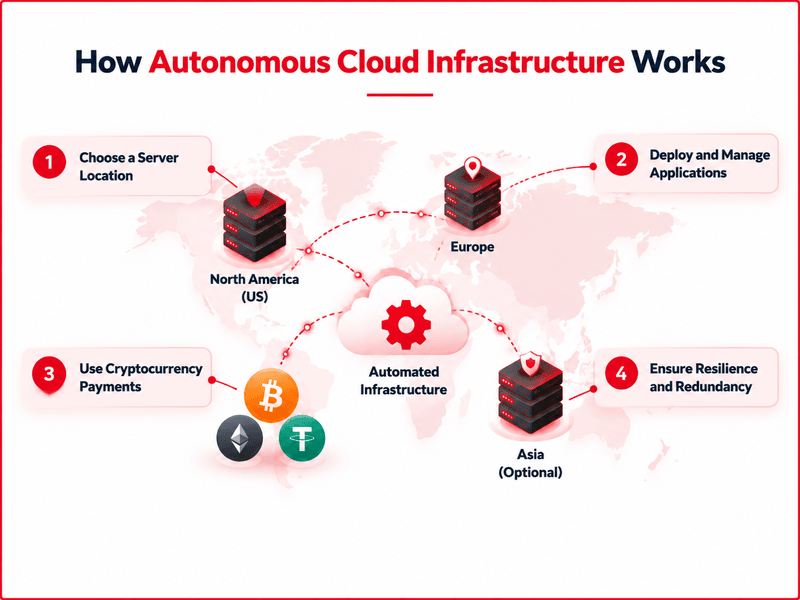
When combined with decentralized technologies, this approach can reduce dependence on a single provider or point of control.
Several technologies contribute to this model:
- Virtual private servers (VPS): Virtual machines provide dedicated portions of a physical server’s computing resources and allow users to manage their own software.
- Decentralized storage: Distributed networks can store data across multiple nodes rather than relying on one storage provider.
- Blockchain networks: Blockchains maintain shared records and coordinate transactions or other operations according to their protocols.
- Automation tools: Software can deploy applications and restart workloads when problems occur.
- Cryptocurrency payments: Supported digital currencies provide an alternative to conventional payment methods for purchasing hosting services.
These technologies serve different purposes. A VPS purchased with cryptocurrency is still a centrally managed hosting service if one company controls the underlying hardware and account.
Similarly, a website that uses blockchain transactions may still depend on conventional servers to deliver its pages and process requests.
Why Privacy-Conscious Users Are Exploring Crypto Hosting
Traditional hosting providers commonly accept credit cards, bank transfers, and other conventional payment methods. These options are convenient, but they may connect a hosting account to identifiable billing information.
Some hosting providers also accept cryptocurrency, giving customers another way to pay for server resources.
For privacy-conscious developers, this can offer several practical benefits.
An Alternative to Traditional Payment Systems
Cryptocurrency can provide an additional payment option for people who prefer not to use a bank card for every online service. Availability depends on the provider, supported currencies, and applicable restrictions.
More Flexibility for International Customers
Some users face limitations when paying for international services through conventional banking channels. Where accepted, cryptocurrency may offer another way to complete a purchase.
Greater Separation Between Billing and Banking Records
Depending on the payment method and provider, crypto payments may reduce the amount of traditional banking information shared during checkout.
However, blockchain transactions can be traceable, and exchanges, payment processors, and hosting companies may still collect identifying information.
More Control Over Server Configuration
A self-managed VPS can give developers root or administrative access to install software, configure firewalls, manage applications, and control how their services operate within the provider’s rules.
It is important to understand the limits. Cryptocurrency payments do not guarantee anonymity or prevent a hosting provider from suspending a service.
Traditional Hosting vs. Crypto-Paid Hosting
Crypto-paid hosting is primarily a payment option. It does not automatically represent a different hosting architecture or a higher level of privacy.
| Feature | Traditional Hosting | Crypto-Paid Hosting |
|---|---|---|
| Payment methods | Cards, bank transfers, and other supported methods | Supported cryptocurrencies, sometimes alongside conventional payments |
| Billing privacy | Billing may be linked to banking and account information | May reduce reliance on traditional banking details |
| Identity checks | Depend on provider policies and applicable rules | Also depend on provider policies and applicable rules |
| International access | Depends on supported payment methods and restrictions | May offer an alternative where conventional payments are unavailable |
| Service reliability | Depends on infrastructure, maintenance, and redundancy | Depends on the same technical factors |
| Security | Requires updates, access controls, and backups | Requires the same security measures |
The most important question is not whether a hosting provider accepts cryptocurrency. It is whether the provider offers the infrastructure and privacy controls your project needs.
Choosing a VPS for Privacy-Focused Applications
A virtual private server can be useful for developers who want more control over their software environment than basic shared hosting provides.
For example, a VPS can host a personal website, an application backend, an API endpoint, a self-managed monitoring service, or components of a decentralized application.
Before choosing a server, consider the following factors.
Server Location and Network Performance
The physical location of a server affects latency, routing, and the legal environment in which the service operates.
A server in Germany may be suitable for applications serving European users. A server in the United States may be more practical for services whose primary audience is in North America.
For international projects, deploying services in multiple regions can improve performance and provide alternatives if one location experiences an outage.
However, a particular country does not automatically guarantee better privacy. Review the provider’s data handling practices and applicable laws before selecting a location.
CPU, Memory, and Storage
Different workloads require different resources. A small website may operate comfortably on a modest VPS, while an API handling heavy traffic or a blockchain node may need substantially more computing power and storage.
NVMe storage can provide fast data access, while sufficient RAM and CPU capacity help applications handle concurrent requests.
For blockchain workloads, check the current hardware requirements of the specific network and software. Storage needs can be particularly demanding for nodes that retain extensive historical data.
Do not pay for resources you do not need, but leave enough capacity for expected growth.
Administrative Access and Network Controls
Root access gives administrators greater control over the server’s software and configuration. It also means they are responsible for many important security decisions.
Look for support for SSH key authentication, firewall configuration, security updates, monitoring, and reliable backup options.
These features are more important to day-to-day security than whether a provider accepts a particular cryptocurrency.
Securing Decentralized Applications and Web Services
A privacy-focused hosting strategy must include practical security measures. Even a well-configured server can be compromised if software is outdated, credentials are exposed, or backups are unavailable.
The following steps help reduce common risks.
1. Use strong authentication. Prefer SSH keys over password-based remote access where appropriate. Disable unnecessary login methods and restrict administrative access.
2. Keep software updated. Apply security patches to the operating system, web server, application dependencies, and other exposed services.
3. Configure firewalls carefully. Allow only the network connections required for your application. Avoid exposing administrative interfaces or internal services to the public internet unnecessarily.
4. Maintain independent backups. Store backups separately from the production server and test recovery procedures. A backup that has never been restored is not a reliable recovery plan.
5. Monitor server activity. Review system logs, resource usage, unusual traffic, and service health. Monitoring helps identify problems before they become prolonged outages.
6. Plan for service failure. For critical applications, consider redundant instances or multiple regions. A second server is useful only if it can take over when the primary server fails.
These practices apply to conventional and crypto-paid hosting alike.
How VPNs and VPS Hosting Work Together
VPNs and VPS hosting are sometimes discussed together because both can play a role in a privacy-conscious technical setup. However, they solve different problems.
A virtual private server provides computing resources for running applications and services. A virtual private network encrypts traffic between a device and a VPN server, helping protect that connection and masking the user’s original IP address from the destination in many common configurations.
For example, a developer might use a VPN when connecting to a remote server over an untrusted network. The developer might then run a website or API on a separately hosted VPS.
These technologies can complement each other, but neither replaces the other.
A VPN does not automatically secure a poorly configured VPS. Likewise, hosting a website on a VPS does not make visitors anonymous or hide the server’s IP address.
Users should also understand the trust involved. A VPN provider may be able to observe certain crypto connection information, while a hosting provider may control the physical server and retain operational logs. The exact visibility depends on encryption and configuration.
For better privacy, evaluate each service independently rather than assuming that combining two technologies guarantees complete anonymity.
What to Check Before Choosing a Crypto Hosting Provider
If you plan to pay for hosting with cryptocurrency, review the provider carefully before committing.
Consider these questions:
- Which cryptocurrencies and networks are supported, and what transaction fees may apply?
- Does the provider require identity verification for your chosen service or payment method?
- What personal information is collected, how long is it retained, and under what circumstances can it be disclosed?
- Which server locations and hardware configurations are available?
- Are backups, DDoS protection, monitoring, and support included in the plan or charged separately?
- What are the refund, cancellation, suspension, and acceptable-use policies?
- Can you migrate your data and applications to another provider if necessary?
Remember that cryptocurrency transfers are often difficult or impossible to reverse. Confirm the payment address, network, amount, and provider terms before sending funds.
For those comparing crypto-friendly hosting providers, Hosting Bitcoin offers US-based VPS options worth reviewing. Visit https://hosting-bitcoin.com/f/vps-in-united-states-of-america to explore the available options and compare current plans, payment methods, security features, and privacy policies before making a decision.
The Future of Autonomous Cloud Infrastructure
Autonomous and decentralized infrastructure offers new ways to manage applications and reduce reliance on individual systems.
Cryptocurrency payments can add flexibility to the purchasing process, while VPS hosting gives developers control over their software environments. Distributed storage with automated recovery and multi-region deployment can further improve the resilience of a well-designed system.
Still, no single technology provides complete privacy, security, or censorship resistance. Those goals depend on how the infrastructure is built, who operates it, what data is collected, and how failures are handled.
For developers and privacy-conscious users, the best starting point is to identify the risks they want to reduce, select appropriate infrastructure, and apply sound security practices from the beginning.