


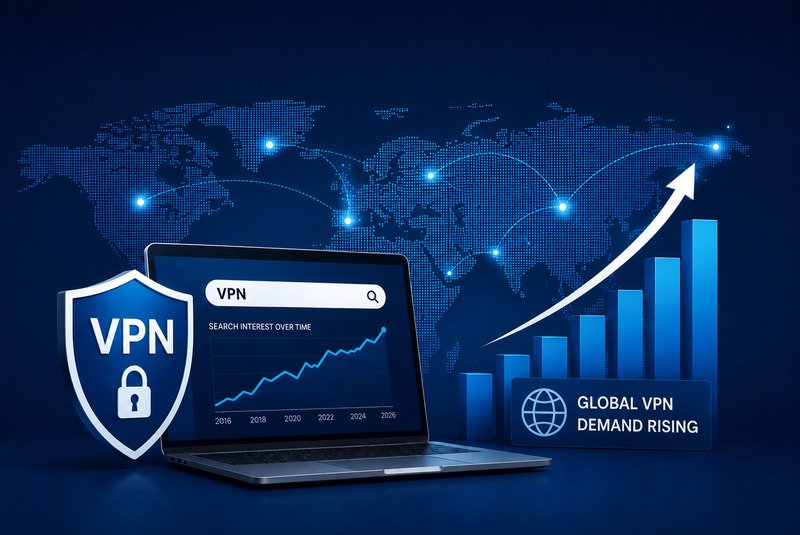
Search activity began climbing again in early 2024, suggesting that demand for VPNs remains strong as privacy concerns, internet restrictions, cyber threats, and remote work continue to shape how people use the internet.
VPNs were once seen mainly as workplace tools for securely connecting to company networks. Today, they are widely used for privacy, security, remote work, travel, gaming, and accessing restricted online content.
The latest data suggests that this demand is becoming a lasting part of how people use the internet.
Internet Restrictions Can Trigger Major VPN Search Spikes
One of the clearest drivers of VPN interest is restricted internet access.
Research found that VPN-related searches can rise by as much as 3,000% following government-imposed internet blocks. These sudden spikes show how quickly people turn to VPNs when websites, apps, or online services become difficult to access.
The trend is not limited to countries traditionally associated with strict internet censorship. It also points to tighter online controls and regulatory measures in markets including the US, UK, France, and Australia.
Asia-Pacific remains especially important to the VPN industry because of its large online population, heavy reliance on mobile internet, and strong VPN adoption in countries such as India and Indonesia.
The pattern is straightforward: when people feel that their access to the open internet is becoming more limited, interest in tools that can restore that access often increases.
VPN Adoption Has Also Increased
Search interest is only part of the story. Actual VPN adoption has grown as well.
According to researched data, average VPN adoption increased from 6.95% in 2020 to 10.58% in 2024.
That points to a gradual shift rather than a temporary surge caused by a single event.
Estimates of the total number of VPN users vary depending on the source and methodology. Swif’s 2026 VPN statistics, for example, estimate that around 1.6 billion people worldwide use a VPN, while other industry estimates place the figure even higher.
Whatever the exact number, the broader picture is clear: VPN use has reached a massive global scale.
Countries such as the UAE, Indonesia, and India regularly rank among markets with high levels of VPN usage.
As the market becomes larger, percentage growth may naturally appear slower. But even modest increases can now represent tens of millions of additional users.
Google Search Data Shows Interest Is Recovering
Search data tells a similar story.
According to Surfshark’s VPN usage analysis, global Google search interest in VPNs increased steadily for more than a decade before reaching a peak in 2022.
Interest declined somewhat after that peak but began moving upward again in early 2024.
That rebound is important.
It suggests that VPN demand was not simply a temporary result of the pandemic or the sudden shift to remote work. Instead, new reasons for using VPNs continue to emerge.
Work remains a particularly important driver. Surfshark found that work-related VPN searches accounted for an average of around 50% of the search volume across the VPN use cases it analyzed, ahead of categories such as gaming, travel, and general privacy.
Remote and hybrid work may therefore remain a major source of long-term VPN demand even as consumer privacy and internet-access concerns grow alongside it.
The VPN Market Is Growing Too
The financial side of the industry reflects the same broader trend.
According to SQ Magazine’s VPN statistics roundup, the global VPN services market was valued at around $61.42 billion in 2024 and approximately $71.25 billion in 2025.
That represents growth of roughly 16% in a single year.
Industry forecasts also suggest that the global VPN user base could eventually reach 2 billion people.
Market-size estimates vary between research firms, so individual projections should be treated with some caution. Still, the overall direction across multiple reports remains consistent: VPN services have developed into a major global technology market.
Why VPN Interest Remains Strong
There is no single reason people are searching for VPNs.
Instead, several long-term trends are pushing demand in the same direction.
Cybercrime remains a concern for both individuals and businesses. Data breaches continue to expose personal information. Public Wi-Fi can create additional security risks. Governments in some countries restrict access to websites, apps, and online platforms. At the same time, consumers have become increasingly aware of how much personal data is collected by websites, advertisers, internet providers, and technology companies.
VPNs do not solve every online privacy or security problem. But they can provide an additional layer of protection by encrypting internet traffic and masking a user’s public IP address.
For many people, that is enough to make them worth considering.
The reasons for using a VPN have also become broader. Someone may use one for work in the morning, connect through it on public Wi-Fi while traveling, and use it later to improve privacy while browsing.
That flexibility helps explain why VPN demand has remained resilient even after earlier search spikes faded.
VPN Search Interest Looks More Structural Than Temporary
The strongest conclusion from the available data is not that VPN searches will rise every year without interruption.
Search interest can fall, rebound, and spike sharply when major events occur.
What matters is the longer-term trend.
VPN interest has expanded far beyond its early role as a specialist business technology. Today, demand is supported by several forces at once: remote work, cybersecurity concerns, privacy awareness, internet restrictions, travel, and growing dependence on digital services.
Search interest peaked in 2022 and later declined, but the renewed growth seen since early 2024 suggests that people have not lost interest in VPNs.
Quite the opposite.
As more of everyday life moves online, tools that promise greater privacy, security, and control over internet access are likely to remain highly relevant.
For VPNs, 2026 looks less like the end of a trend and more like the continuation of a much larger shift.