

Businesses that can collect and analyze market data faster often gain valuable insights into changing consumer behavior.
Understanding competitor strategies and responding quickly to customer demand can significantly improve business performance. However, gathering valuable market insights manually is no longer practical.
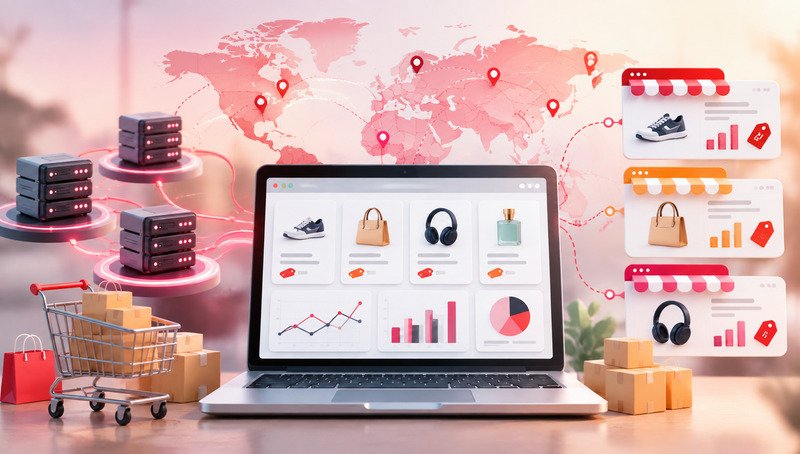
Product prices change frequently, and competitors continuously update their offers. To stay competitive, many e-commerce companies now use automated data collection systems supported by reliable proxy infrastructure.
What Is Competitive Intelligence in E-commerce?
Competitive intelligence refers to the process of collecting and analyzing publicly available information about competitors, customers, latest trends, and market conditions to make better business decisions.
For online retailers, competitive intelligence may include monitoring:
- Competitor product prices
- Product availability and stock updates
- New product launches
- Customer reviews and ratings
- Promotional campaigns
- Search rankings
- Marketplace listings
- Regional pricing differences
The goal is not to access private information but to organize publicly available market data into actionable insights.
For example, an online fashion retailer may monitor competitors’ seasonal discounts and inventory changes to understand market movement and adjust its own strategy.
Why Proxies Are Important for E-commerce Data Collection
Collecting competitive data at scale requires sending numerous requests to different websites. When too many requests come from the same IP address, websites may apply rate limits or restrict access to prevent automated activity.
This is where proxy servers become an important part of the infrastructure.
A proxy works as an intermediary between a user’s system and the internet. Instead of every request coming from the same IP address, businesses can route requests through different IP addresses, allowing their data collection systems to operate more consistently.
For large-scale e-commerce research, businesses often use datacenter proxy servers because they provide fast connections, scalable IP availability, and efficient performance for high-volume data operations.
The right proxy solution helps companies collect market information while maintaining reliable access and improving data accuracy.
Key Ways E-commerce Businesses Use Proxies for Competitive Intelligence
Once a reliable proxy setup is in place, businesses can turn scattered market data into practical insights. Here are the most common ways e-commerce companies put them to work.
1. Monitoring Competitor Prices
Pricing is one of the most important factors in online shopping decisions. A small price difference can influence where customers choose to buy.
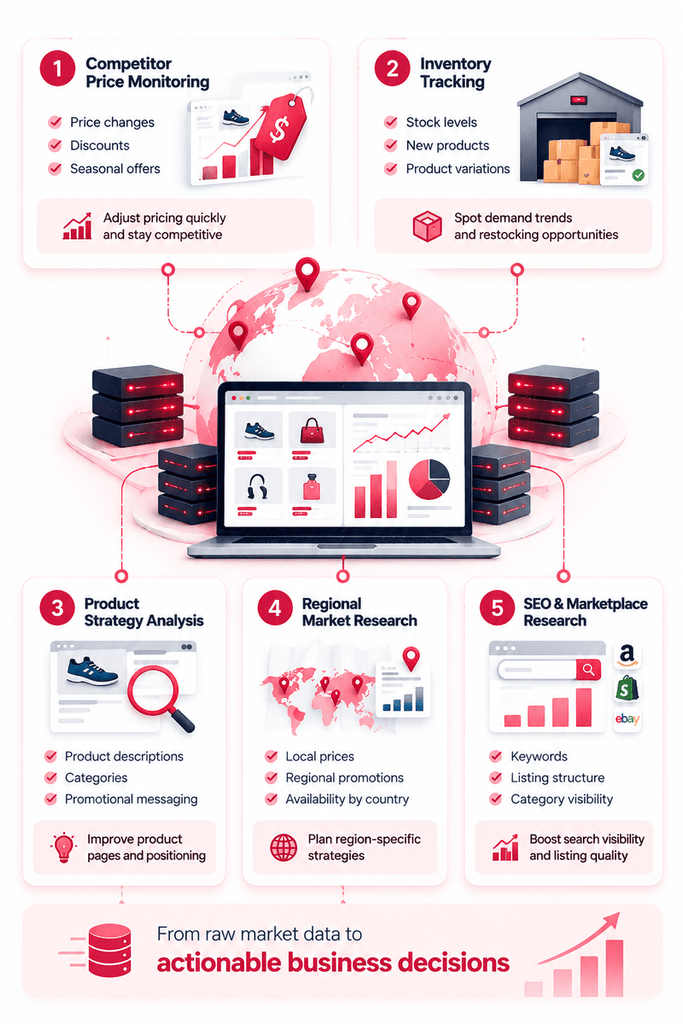
E-commerce companies use automated monitoring systems to track competitor pricing across multiple websites. This allows them to identify:
- Price changes
- Discount campaigns
- Seasonal offers
- Product bundle strategies
- Market price trends
For example, an electronics retailer can monitor competitor prices for smartphones, laptops, and accessories. If a competitor reduces prices during a promotion, the retailer can analyze the change and decide whether an adjustment is necessary.
Without automation, tracking hundreds or thousands of products manually would require significant time and resources.
2. Tracking Product Availability and Inventory Changes
Inventory information provides valuable insight into market demand.
Businesses can monitor:
- Which products are selling quickly
- Which items are frequently out of stock
- New products added by competitors
- Changes in product variations
This information helps companies understand customer preferences and identify opportunities.
For instance, if multiple competitors are running out of stock for a popular product category, another retailer may recognize an opportunity to increase inventory and capture additional demand.
3. Analyzing Competitor Product Strategies
Successful e-commerce businesses continuously study how competitors present their products.
Competitive intelligence can reveal:
- Product descriptions
- Pricing structures
- Category organization
- Promotional messaging
- Customer engagement strategies
A company launching a new product line can analyze competitor positioning to understand market expectations and identify ways to improve its own product pages.
4. Understanding Regional Market Differences
Online stores often display different prices, availability, and promotions depending on location.
A customer browsing from the United States may see different offers compared with someone accessing the same store from Asia or Europe.
Proxy networks with location-based IP options allow businesses to collect market information from different regions and understand:
- Local pricing strategies
- Regional promotions
- Product availability
- Customer preferences
This is especially useful for international brands operating across multiple markets.
5. Improving SEO and Marketplace Research
Competitive intelligence is also valuable for search visibility.
E-commerce brands analyze competitors to understand:
- Which keywords competitors target
- How product pages are structured
- Which categories receive more visibility
- How marketplace listings are optimized
This information helps businesses improve their own product descriptions and search strategies.
For example, a marketplace seller can analyze competitor listings to identify common customer questions and create more useful product information.
Building an Effective Proxy-Based Competitive Intelligence Strategy
Using proxies alone is not enough. Successful competitive intelligence requires a complete workflow that includes:
Define Clear Data Goals
Businesses should first determine what information they need. Monitoring thousands of irrelevant data points can create unnecessary complexity.
Examples of focused goals:
- Track competitor prices for specific products
- Monitor category changes
- Analyze promotional campaigns
- Compare regional markets
Use Reliable Data Collection Methods
Data quality is more important than simply collecting large amounts of information.
Companies should focus on:
- Accurate data extraction
- Regular monitoring schedules
- Proper data organization
- Quality validation
Respect Website Policies and Ethical Boundaries
Competitive intelligence should also focus on publicly available information and responsible data practices.
Businesses should avoid collecting restricted information and ensure their activities follow applicable local and federal laws alongside website terms.
The Future of Competitive Intelligence in E-commerce
As online competition continues to grow, businesses will increasingly rely on automation and real-time insights.
Artificial intelligence and advanced analytics are making it easier to transform large amounts of market data into meaningful business decisions.
Companies that understand customer behavior and competitor movements can respond faster to market changes.
Proxy infrastructure will remain an important technical component of these systems by supporting reliable and scalable data collection.
The Bottom Line
Competitive intelligence has become a valuable advantage for modern e-commerce businesses. The ability to monitor pricing, understand market trends, analyze competitors, and identify new opportunities allows companies to make decisions based on real data rather than assumptions.
Proxies provide the technical foundation needed for scalable online research by helping businesses collect publicly available information more efficiently.
When combined with responsible data practices and effective analytics, proxy-powered competitive intelligence can help e-commerce companies adapt quickly and compete more effectively in an increasingly digital marketplace.