

Gen Z’s privacy habits come directly from what they’ve watched happen online, to their friends, their data, and sometimes themselves. Here, we will break down why Gen Z cares so much about online privacy, and what government data reveals about the risks driving that concern.
Gen Z Grew Up Watching Data Breaches Happen
Older generations learned about privacy risks slowly, over years of headlines. Gen Z watched breaches happen in real time, often affecting apps and platforms they used every day.
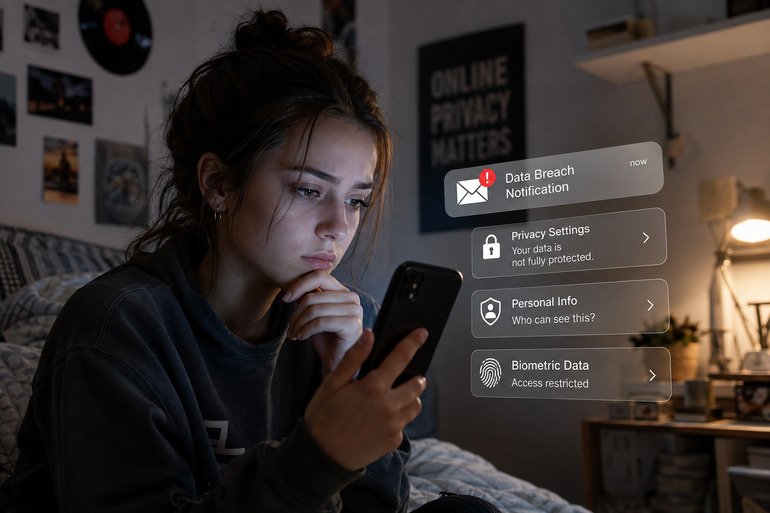
A Constant Stream of Breach Notifications
The Identity Theft Resource Center logged a record 3,322 data compromises in 2025, a jump of 79% over five years. Gen Z didn’t read about this in a textbook.
They lived through it, receiving breach notification emails from the same apps and stores they use daily. This constant exposure taught them that no platform is fully safe, no matter how trusted it looks.
Identity Theft Reports Keep Climbing
The FTC’s Consumer Sentinel Network receives more than a million identity theft reports every year. Young adults submit a large share of these reports. Since they spend more time on the exact platforms- i.e., social media, gaming, messaging apps- where scammers and data thieves operate most actively. Growing up inside this reporting data, rather than just reading about it, shaped how Gen Z treats their personal information today.
Regulators Are Now Targeting the Platforms Gen Z Uses Daily
Gen Z didn’t develop privacy instincts in a vacuum. Government regulators have spent the last two years building an entire enforcement record around exactly the platforms this generation lives on.
The FTC Cracked Down on Kids’ and Teens’ Data
In January 2025, the FTC finalized major updates to the Children’s Online Privacy Protection Rule (COPPA). The update limits how companies can monetize children’s data and expands what counts as personal information, including biometric identifiers.
Months earlier, FTC staff published a report finding that large social media and video streaming companies engaged in vast surveillance of users, with weak privacy controls and poor safeguards for kids and teens. Gen Z didn’t need to read the full report. Many lived the exact experience it described.
Lawsuits Against Major Platforms Reached Gen Z’s Feeds
The FTC didn’t stop at rulemaking. It sued TikTok and ByteDance over alleged violations of children’s privacy law. It settled with the maker of a popular video game for $20 million after finding the company collected children’s personal information without parental consent.
These stories moved through the exact platforms Gen Z uses to get news, group chats, comment sections, and short-form video. A privacy scandal involving a familiar app spreads through Gen Z’s networks fast, and it sticks.
New Federal Law Targets Non-Consensual Intimate Images
The FTC now enforces Section 3 of the Take It Down Act, a law that took effect in May 2026. It requires covered platforms to remove non-consensual intimate images within 48 hours of a valid request.
Congress passed this law because these images were spreading fastest among younger users, on the exact platforms Gen Z relies on to connect with friends. The existence of this law confirms what Gen Z already suspected: the platforms they use don’t automatically protect them.
Gen Z’s Privacy Behavior Doesn’t Match Older Assumptions
Many people assume young people don’t care about privacy because they share so much online. Research contradicts that assumption directly.
They Take More Protective Steps Than Other Generations
Research from the Oliver Wyman Forum found that Gen Z clears cookies, uses anonymous browsers, and encrypts communications roughly twice as often as other generations.
They combine constant sharing with constant protection, running both habits side by side rather than choosing one over the other.
They Walk Away From Platforms Over Privacy Concerns
A Usercentrics survey found that 35% of Gen Z respondents have stopped using a social media platform specifically over data privacy concerns, the highest share of any generation surveyed, including Millennials, Gen X, and Baby Boomers. Older generations tend to complain about a platform and keep using it anyway. Gen Z tends to just leave.
Global Regulators Confirm the Same Pattern
This isn’t a purely American trend. Government bodies across the world report the same generational shift.
The EU Ranks Child and Youth Protection as a Top Priority
The European Commission’s Special Eurobarometer found that 92% of Europeans consider strengthening online protection for children and young people a top policy priority.
The same survey found that 93% of respondents worry specifically about social media’s effect on young people’s mental health. This level of public concern doesn’t emerge without a real, visible problem behind it.
Younger EU Citizens Report High Exposure to Online Harm
A separate EU Youth Survey found that 76% of young respondents reported being exposed to disinformation and fake news in the past week.
Constant exposure to manipulated content pushes young users toward more skepticism about who accesses their data and how it gets used.
Why This Matters Going Forward
Gen Z’s privacy caution isn’t paranoia. It’s a direct, learned response to a documented pattern: recurring data breaches, aggressive government enforcement actions, and platforms repeatedly caught mishandling young users’ information.
The generations before them mostly encountered these risks as adults, with fewer digital habits already locked in. Gen Z encountered them earlier, faster, and more often, and it changed how they behave online.
Final Say
Gen Z didn’t inherit privacy anxiety from their parents. They built it themselves, out of breach notifications, FTC enforcement actions, and platforms that got caught mishandling their data in real time.
Government agencies in the U.S. and the EU keep confirming the same story from different angles: today’s platforms weren’t built with young users’ privacy in mind, and Gen Z noticed first.